CASE STUDY / INDUSTRIAL IOT · FIELD DELIVERY
From a sensor on the shop floor to an operational platform.
Problem
FabCity Hamburg's urban fabrication labs had zero visibility into their energy consumption. Thirty-plus 3D printers, laser cutters, and workshop tools consumed energy without monitoring or optimization. The labs needed a system that spans the full vertical — from custom sensor hardware to ML-powered analytics — and that non-technical FabLab operators could actually use.
My Role & Responsibilities
- Built and deployed the full platform across three FabCity sites: JUPITER OpenSpace, Fabulous St. Pauli, and FABRIC
- Wrote custom ESP32 sensor firmware (C++) with MPU6050 (accelerometer/gyro), MAX6675 (thermocouple), and DHT22 (temperature/humidity) — MQTT publishing, OTA firmware updates, WiFi reconnection handling
- Integrated Shelly smart plugs for equipment-level power monitoring across 30+ machines
- Designed 6+ Node-RED data flows — Ingest Shelly MQTT, Manual Model Training, Analysis API, Live Predictor, Fetch Environment, DPP API, ESP Sensors
- Built a Python Flask API for Digital Product Passports — per-job energy tracking with PDF report generation
- Developed the ML Worker service for predictive analytics and model training
- Built the Interactive Analysis engine — configurable deep-dive analytics with device selection, time ranges, and temperature drivers
- Created pre-provisioned Grafana dashboards — zero manual configuration, everything ready on deploy
- Integrated Raspberry Pi 4 + OctoPrint to bridge legacy 3D printers to SimplyPrint IoT cloud
- Containerized the entire platform into 7 Docker services with zero-touch deployment
- Conducted on-site workshops demonstrating the system to FabLab operators
Architecture
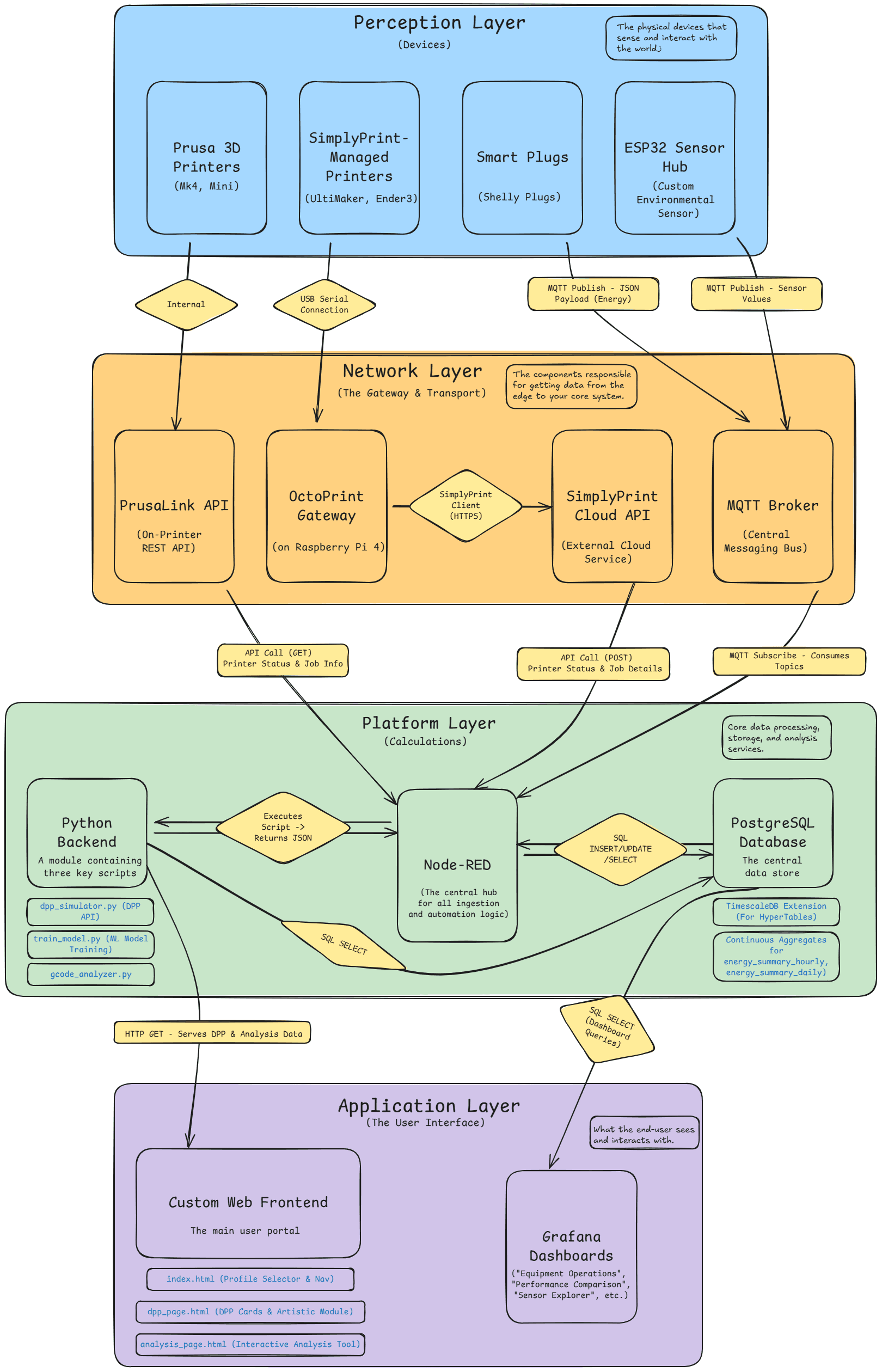
7 containerized services — docker compose up → fully operational platform:
- Hardware Layer: ESP32 sensor hubs, Shelly plugs, Raspberry Pi + OctoPrint bridge for legacy printers
- Ingestion Layer: Mosquitto MQTT broker + Node-RED flows (ingest, model training, live predictor, DPP, environment)
- Backend Layer: Flask API, ML Worker, Interactive Analysis engine
- Data Layer: PostgreSQL + TimescaleDB for high-volume time-series storage
- Visualization Layer: pre-provisioned Grafana dashboards + Nginx-hosted UI and CRUD modules
Sensors / Smart Plugs / Printers
              ↓
       MQTT Broker + Node-RED
              ↓
 Flask API + ML Worker + Analysis Engine
              ↓
       PostgreSQL / TimescaleDB
              ↓
      Grafana + Web UI (Nginx)
Tech Stack
- Hardware: ESP32 (custom sensor firmware in C++), Raspberry Pi 4, Shelly Plus Plugs
- Sensors: MPU6050 (accelerometer/gyro), MAX6675 (thermocouple), DHT22 (temperature/humidity)
- Data Pipeline: Node-RED (6+ flows), MQTT (Eclipse Mosquitto), Modbus
- Backend: Python Flask (DPP API + reports), Python ML Worker (predictive analytics)
- Database: PostgreSQL + TimescaleDB — time-series optimized with chunking and compression
- Visualization: Grafana with pre-provisioned dashboards — zero manual config
- Frontend: HTML/CSS/JavaScript with device management CRUD interface
- 3D Print Integration: OctoPrint, SimplyPrint Cloud, Prusa Connect APIs
- Infrastructure: Docker-Compose (7 services), Nginx reverse proxy
- Language Mix: HTML 65.9%, Python 25.0%, JavaScript 5.2%, C++ 1.2%, PLpgSQL 1.2%
Demo
The live platform is running at lauds-demo.intel50001.com — real-time energy data, sensor readings, ML predictions, and equipment status from the deployed FabLab sites.
Platform Screenshots
Results & Impact
- 3 FabLab sites fully deployed with real-time monitoring across 30+ machines — this is a production system, not a prototype
- Full hardware-to-ML vertical — from custom C++ sensor firmware to Python ML models, all in one platform
- Zero-touch deployment —
docker compose up→ 7 services running, dashboards provisioned, flows active, no manual config - Digital Product Passports — per-job energy tracking with automated PDF reports, enabling transparency and sustainability documentation per manufactured item
- Human-centric interfaces — dashboards designed and validated with non-technical FabLab operators through on-site workshops
- ML-powered predictive analytics — model training, live prediction, and interactive analysis for energy optimization
- Bridge between legacy equipment and modern IoT — Raspberry Pi + OctoPrint connecting old 3D printers to SimplyPrint cloud
Challenges & Lessons Learned
- Field deployment vs. lab prototype — sensor hubs needed robust enclosures, reliable WiFi reconnection, and graceful MQTT error recovery. What works on a bench fails in a dusty workshop.
- Legacy equipment integration — older 3D printers without network capabilities required the Raspberry Pi + OctoPrint bridge, adding complexity but achieving full fleet coverage
- Node-RED flow complexity — 6+ processing tabs with ML training, live prediction, and DPP generation required careful flow organization and error handling to prevent cascading failures
- User-centric dashboard design — iterating with non-technical FabLab operators taught me that simpler visualizations with clear action items outperform information-dense dashboards every time
How AI/Agents Were Used
AI-augmented development accelerated every layer: custom VS Code agents generated ESP32 firmware boilerplate (sensor reading, MQTT publishing, error handling) which I validated against hardware specs and tested on physical devices. Node-RED flow designs and Grafana dashboard configurations were generated through agentic workflows, then refined through field testing. The ML Worker itself runs predictive models trained on real sensor data.
NEXT PROJECT