CASE STUDY / ENERGY INTELLIGENCE
HumanEnerDIA
Making industrial energy data useful to people.
Problem
Industrial energy management is labor-intensive, technically demanding, and fragmented. Facility managers manually interpret complex energy data, navigate ISO 50001 regulatory requirements without guidance, and make optimization decisions blind — no voice interaction, no conversational assistance, no intelligent analytics. Existing EnMS platforms are built for engineers, not operators. I built a platform that makes industrial energy intelligence accessible through voice, chat, and visual dashboards.
My Role & Responsibilities
- Core Developer and System Integrator for the entire HumanEnerDIA platform
- Built and integrated the OVOS voice assistant — custom skills for hands-free energy data queries on the factory floor
- Implemented the RASA chatbot for text-based EnMS guidance, ISO 50001 workflow assistance, and compliance documentation
- Developed the FastAPI analytics backend with time-series aggregation, anomaly detection, ML model training, and forecasting
- Built 6 KPI dashboards with real-time metrics, radar charts, and trend analysis
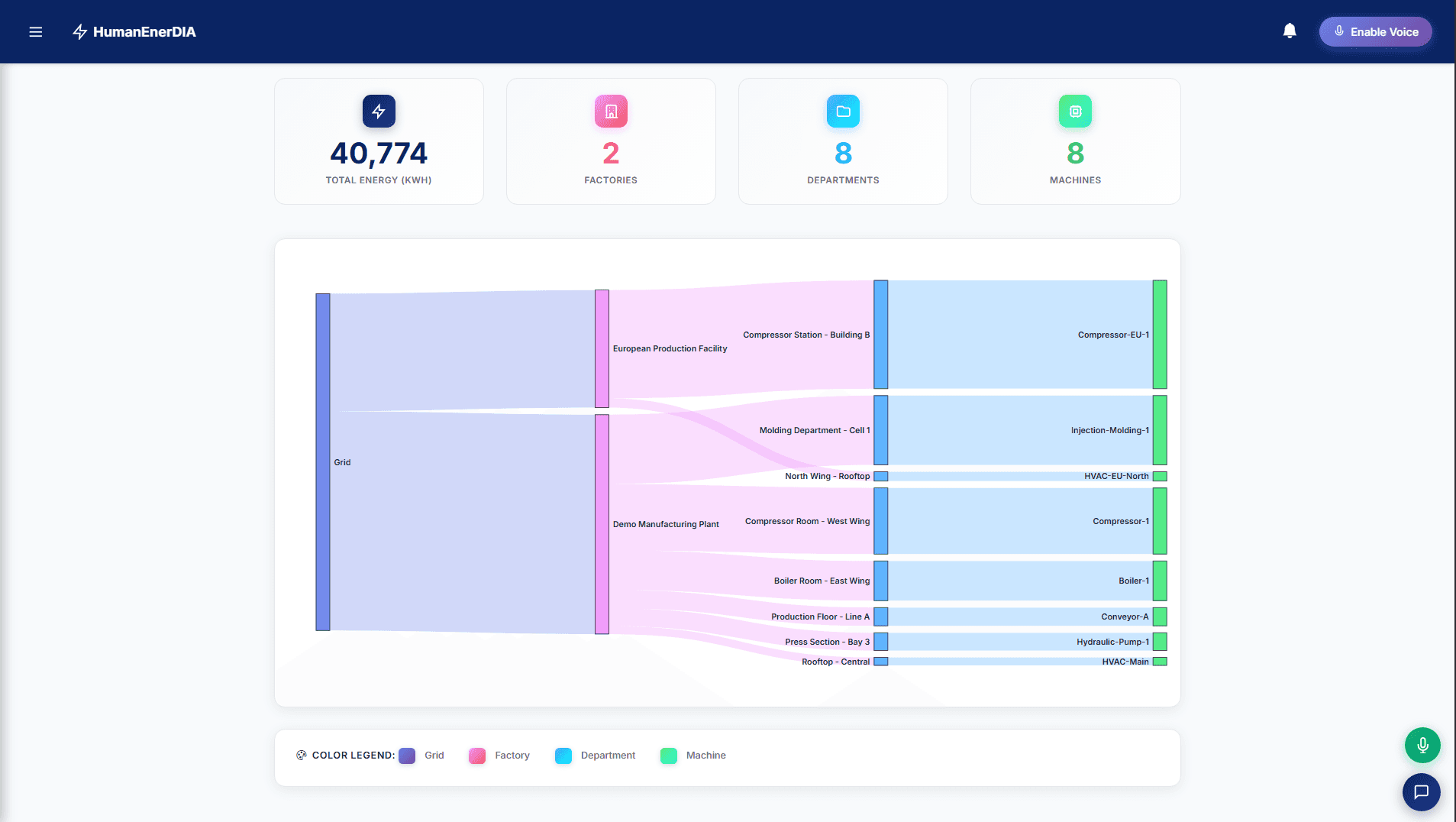
- Implemented Sankey energy flow visualization — Grid → Factory → Departments → individual Machines
- Built ARIMA/Prophet forecasting with model performance tracking (R², RMSE, drift detection)
- Developed machine comparison analytics — surfaced equipment-level efficiency differences and estimated savings scenarios
- Created 10 Grafana dashboards (Factory Overview, Executive Summary, Anomaly Detection, Real-Time Production, Energy Cost Analytics, Environmental Impact, ISO 50001 EnPI, Machine Health, Operational Efficiency, Predictive Analytics)
- Designed Node-RED data pipelines — MQTT → Parse → Route → Process → PostgreSQL
- Built the Factory Simulator REST API (Swagger/OpenAPI) for testing and development
- Integrated LLM capabilities for natural language energy report generation
Architecture
- Interface Layer: OVOS voice assistant, RASA chatbot, web dashboard, and 10 Grafana views
- Intelligence Layer: FastAPI analytics, ARIMA/Prophet forecasting, anomaly detection, Sankey flow engine, machine comparison, LLM reporting
- Pipeline Layer: Node-RED processing chain (MQTT → parse → route → process) and simulator API
- Data Layer: TimescaleDB with 19.2M+ readings and 138 baseline models
- IoT Layer: smart plugs, meters, and environmental sensors
Voice / Chat / Dashboard / Grafana
               ↓
        FastAPI Intelligence Core
               ↓
Node-RED Pipeline + Simulator + MQTT
               ↓
 TimescaleDB (readings + baseline models)
               ↓
     KPIs, forecasts, anomalies, reports
Tech Stack
- Voice AI: OVOS (Open Voice OS) — custom skills for hands-free energy queries
- Chatbot: RASA — domain-specific NLU for EnMS guidance and ISO 50001 compliance workflows
- Backend: FastAPI (Python) — analytics, ML training, anomaly detection, forecasting
- ML/Forecasting: ARIMA, Prophet — with R², RMSE tracking and drift detection
- LLM Integration: Natural language report generation and operator query handling
- Data Pipeline: Node-RED (MQTT → Parse → Route → Process → PostgreSQL), Factory Simulator API
- Database: TimescaleDB — time-series optimized PostgreSQL handling 19.2M+ readings
- Visualization: 10 Grafana dashboards + custom web analytics (Sankey diagrams, KPI charts, radar charts, heatmaps)
- Infrastructure: Docker, Docker-Compose
- Standards: ISO 50001 framework alignment
Platform Screenshots
Core Platform Views
Analytics & Grafana
Engineering outcomes
- Connected time-series ingestion, analytics, and operator interfaces in one platform rather than leaving them as separate tools.
- Added forecasting and model diagnostics alongside machine-level comparison and energy-flow views.
- Made energy information accessible through dashboards, voice, and text interaction.
- Supported ISO 50001 documentation and audit-preparation workflows; this is workflow support, not a certification claim.
The screenshots show a particular system state and dataset. Displayed readings, consumption values, and model results should be interpreted in that context rather than as independently verified business savings.
Challenges & Lessons Learned
- OVOS custom skill development — sparse documentation required reading source code, engaging with the community, and building deep understanding of the voice pipeline and intent handling system
- Balancing RASA and LLM approaches — used RASA for structured, deterministic workflows (ISO compliance steps) and LLMs for flexible natural language queries and report generation. The boundary between them required careful design.
- Time-series data volume at scale — 19.2M readings required TimescaleDB's chunking, compression, and continuous aggregates to maintain sub-second query performance
- ML model lifecycle — managing 138 baseline models with drift detection, retraining schedules, and performance monitoring (R², RMSE) across 8 machines simultaneously
How AI/Agents Were Used
LLM integration serves three purposes: (1) end-user facing — generating natural language energy reports and answering operator queries about consumption patterns; (2) ML pipeline — ARIMA/Prophet forecasting with automated drift detection and model retraining; (3) development acceleration — using agentic VS Code workflows to rapidly prototype FastAPI endpoints, Node-RED flow configurations, and Grafana dashboard JSON before manual validation and production hardening.
NEXT PROJECT